

MANOJ KUMAR RAWAT
Banking, Agriculture and Rural Finance
P&L • Credit & Risk Management • Institution Building • Development Finance • Climate Finance
India and Emerging Markets
Three decades beginning at ISRO and spanning NABARD, Fullerton India, RBL Bank, ValueFin and IFAD, across commercial banking, priority-sector finance, development finance, regulated-NBFC leadership and rural financial systems. His work has included P&L, credit and risk management, institution building, advisory, mentoring and board-level leadership, with career-wide exposure to approximately USD$ 2 billion in portfolios, financing and capital deployment across banking, agriculture, rural infrastructure and development finance.
He currently leads Rural Rethink Advisory LLP, focused on agriculture, rural and climate finance, and serves on the Governing Board of CLEAN Network.
His current interests include Responsible AI in rural finance, climate finance and carbon markets. The Carbon Trilogy is his three-book effort to connect finance, agriculture and the emerging carbon economy.


Three decades across banking, agriculture, rural finance and development finance.
NABARD | RBL Bank | Fullerton | ISRO | NBFC | IFAD
Manoj Kumar Rawat is a finance professional with over three decades of experience and leadership roles across rural banking, agriculture finance, MSME finance, priority-sector lending and climate-aligned development.
His career spans ISRO, NABARD, Fullerton India, RBL Bank, NBFC leadership, e-NAM and IFAD-related development-finance assignments. His work has also covered irrigation and water-resource finance, watershed development, agricultural value chains, rural infrastructure, post-harvest systems and financial inclusion.
Across these roles, his experience has included commercial banking, agriculture and rural finance, microfinance, smallholder and FPO finance, MSME finance, value-chain and commodity finance, investment credit, refinance and development finance.
His work has focused on building financial businesses and systems that balance growth with credit management, strong institutions and effective field execution.
His work has included national P&L responsibility, credit and risk architecture, FPO and producer-institution finance, and engagement with banks, government, development institutions and international partners.
He is the Founder & CEO of Rural Rethink Advisory LLP, focused on agriculture, rural and climate-aligned finance.
He is an alumnus of G.B. Pant University of Agriculture & Technology and holds qualifications in engineering, finance and banking, along with professional and executive education in governance, ESG and sustainable finance.
Alongside his professional work, he writes on climate finance, carbon markets and rural transition systems and is the author of The Carbon Trilogy, a three-book body of work connecting finance, agriculture and the emerging carbon economy.
JOURNEY
A three-decade career across banking, agriculture and rural finance, priority-sector lending, development finance and regulated financial institutions, beginning at ISRO and spanning NABARD, Fullerton India, RBL Bank, ValueFin and IFAD. Across these roles, his work has involved portfolio, financing and development-finance exposure approximately USD$ 2 billion across banking, agriculture, rural infrastructure and development finance.
RBL BANK
Group EVP & Head, Agriculture & Rural Business, and member of the Management Committee. Held P&L responsibility for an agriculture and rural business of approximately USD$800 mn across 15 states, spanning agriculture, rural retail, MSME, value-chain and commodity finance, warehousing, priority-sector lending and financial inclusion. During this period, RBL Bank was recognised as Best Priority Sector Bank in India for two consecutive years.
FULLERTON
Vice President — Risk Management, Rural & Microfinance, and part of the founding leadership team for the rural business. Led work across credit and risk policy, product architecture, portfolio governance and field operating controls for microfinance and a range of rural credit products. Contributed to building a disciplined, multi-product rural-finance platform across diverse geographies.
NABARD
12 years across investment credit, refinance, rural infrastructure, agriculture finance, financial inclusion and development programmes. Worked across irrigation, warehousing, cold chain, agri-marketing, post-harvest infrastructure, horticulture, rural enterprises and SHG/microfinance linkages. Also worked with NABARD Consultancy Services (NABCONS) and served as PMU In-Charge for the KfW-assisted Indo-German Watershed Development Programme
VALUEFIN
Bootstrapped and led ValueFin, an RBI-registered NBFC, as Founder, MD & CEO of an RBI-registered NBFC, with responsibility across governance, capital, regulation, credit and operations. Built the platform around agriculture value chains, rural enterprises, MSMEs, FPOs, agri-processing, post-harvest infrastructure and selected climate-aligned rural-finance opportunities. The role brought direct experience of building and managing a regulated lending institution from the founder’s side.
IFAD
Senior Consultant & Lead Technical Architect for an agri-finance facility in Africa. Worked on institutional architecture for agricultural finance, including refinancing and pre-financing facilities, credit guarantees, risk-sharing structures, governance arrangements, operating frameworks and implementation roadmaps. The assignment brought together development-finance design with the realities of financial intermediation and rural credit systems.
ISRO
CURRENT ENGAGEMENTS
Started Career with Space Application Centre, ISRO as Scientist Engineer
Founder & CEO, Rural Rethink Advisory LLP, and Governing Board Member, CLEAN Network. Current work spans agriculture, rural and climate-aligned finance, institutional architecture, financial inclusion, FPO and rural-enterprise finance, and Responsible AI for rural financial services.
Manoj is also engaged in research and writing on climate finance, carbon markets and rural transition systems, and is the author of The Carbon Trilogy, a three-book body of work connecting finance, agriculture and the emerging carbon economy.
RESEARCH&
PUBLICATIONS
Research and publications span climate finance, carbon markets, smallholder and rural finance, agricultural finance systems, institutional architecture and sustainable development.
Open-access publications, working papers, preprints, datasets and methodology outputs are available through OSF, Zenodo, Harvard Dataverse, Figshare, SSRN, ScienceDB, ResearchGate and Academia.edu, forming a broader research record alongside books and professional writing.
Author of The Carbon Trilogy, a three-book series exploring the intersection of carbon markets, climate finance, agriculture, rural economies and the emerging carbon economy. The books are written to make complex carbon-market and climate-finance concepts more accessible while connecting policy, finance, institutions and field-level implementation.
Carbon Credit: A Beginner’s Guide↗
An accessible introduction to carbon credits, carbon markets, project development and the institutions shaping the carbon economy.
The Carbon Handshake: The Golden Suture↗
A practitioner-focused exploration of how verified carbon outcomes can connect with finance, institutions and smallholder income through stronger market and settlement architecture.
The Carbon Economy Simplified↗
A broader synthesis of carbon markets, climate finance and the institutional systems shaping the transition to a lower-carbon economy.
BOOKS
Three books. One interconnected carbon economy.
Why carbon matters.
New Launch Offer
Value Edition
Coming Soon

THE CARBON HANDSHAKE
The Golden Suture —
The Practitioner's Guide to India's Carbon Economy

CARBON CREDIT
A BEGINNER'S GUIDE
Demystifying the Carbon Economy
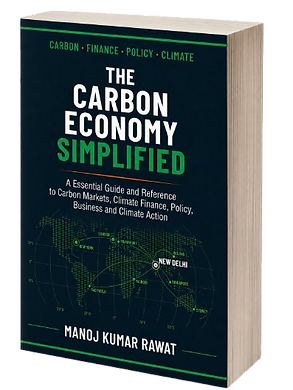
THE CARBON ECONOMY SIMPLIFIED
The Essential Guide and Reference to Markets, Finance, Policy and Climate Action
This is not another book about climate change. It is a practitioner’s guide to the delivery chain of the carbon economy: how verified data becomes credit, how credit supports transition, and how transition becomes trusted income.
The Carbon Handshake explains what is now happening at the intersection of carbon markets, rural finance, agriculture, digital verification, aggregation, blended finance and India’s emerging carbon economy.
Written as an engaging and readable professional guide, it asks a simple question: how does climate value become measurable, financeable, verifiable, tradable and useful in the real economy?
The book is built around four practitioner frameworks:
-
The Golden Suture connects institutions, policy, finance, data and markets.
-
The Digital Spine explains digital MRV and verification architecture.
-
The 1:10 Multiplier frames blended finance and catalytic capital.
-
The 80:20 Rule protects farmer value in carbon-market design.
15 chapters. 32 annexure tables. A comprehensive practitioner’s guide for readers who want to understand how carbon value moves from policy intent to verified action, financeable projects, trusted markets, institutional coordination and real economic transition.
First Edition · May 2026
ISBN (Print): 978-93-5655-401-6
ISBN (eBook): 978-93-5717-312-4
Special Price
Carbon credits are now part of business, finance, policy, agriculture and climate action. Yet the subject remains confusing for most readers — technical, jargon-heavy and hard to navigate. This book helps readers enter that world with clarity and confidence.
Carbon Credit: A Beginner’s Guide is a clear first guide to the carbon economy: how emissions become measurable, how projects create credits, how credits are verified, traded and retired, and why integrity matters.
The book explains carbon credits, carbon markets, MRV, ESG, India’s carbon ecosystem and climate opportunities in simple, structured and readable language.
Written as an engaging and beginner-friendly guide, it asks a simple question: how does a climate-positive activity become a credible carbon credit that can be measured, verified, traded and trusted in the real economy?
The book takes the reader through the foundations of the carbon market:
India’s carbon-market opportunity is explained with practical examples.
18 chapters. Glossary, formulae, bibliography and quick-reference material.
First Edition · August 2025
ISBN (Print): 978-93-343-6282-4
ISBN (eBook): 978-93-343-7713-2
Special Price
Carbon has moved far beyond climate conferences. It now sits inside cost of capital, export invoices, ESG disclosures, climate law, board decisions, bank portfolios, project finance, business strategy and career choices.
The Carbon Economy Simplified explains this full system in clear, practical language. It is designed as a professional reference that reads like a guided journey, building the carbon economy step by step: carbon science, emissions accounting, carbon credits, standards, registries, climate finance, ESG disclosure, carbon markets, policy, law, agriculture, digital MRV, sectoral transition and climate-linked careers.
For a banker, carbon is becoming a risk and finance question.
For an exporter, it is a competitiveness question.
For an ESG professional, it is a disclosure question.
For a policymaker, it is a market-design question.
For a student or young professional, it is a career question.
The book connects the full arc: science to accounting, accounting to markets, markets to finance, finance to policy, policy to business strategy, and finally to the practical decisions that professionals must make.
27 concise chapters. 5 parts. 8 appendices. Glossary. Formulae.
The book is a professional reference for readers who want to understand the carbon economy as a business
First Edition: Coming Soon
ISBN (Print): 978-93-5891-825-0
ISBN (eBook): 978-93-5895-283-4


